
Training apps: which earbuds really let you breathe?
Hi, it’s Gérald.
To let your ears breathe, choose open-ear or bone-conduction headphones, especially for running outdoors. They let ambient sounds through, unlike in-ear models, which provide more isolation.
The right choice also depends on your workout: a secure fit for intense movements, resistance to sweat, and comfort for your ears over time. Here are the key things to look for when choosing sports headphones suited to your training.
What to look for when choosing breathable headphones
- For running in the city, choose an open-ear model that lets you hear traffic.
- For intense movements, check the fit with hooks or wings.
- For worry-free workouts in the sweat, check the water and sweat resistance rating.
- To protect your hearing comfort, start at a moderate volume and take breaks.
- For a noisy gym, opt for noise-canceling in-ear headphones if you don’t need to hear your surroundings.
To compare styles and find models that stay in place as you move, check out our sports headphones tested for stress-free movement and our selection of sports headphones to watch.
Open-ear or in-ear headphones: which should you choose for training?
Open-ear headphones sit at the entrance to the ear or around it. They allow more airflow and keep you connected to ambient sounds, making them a good choice for running outdoors or cycling.
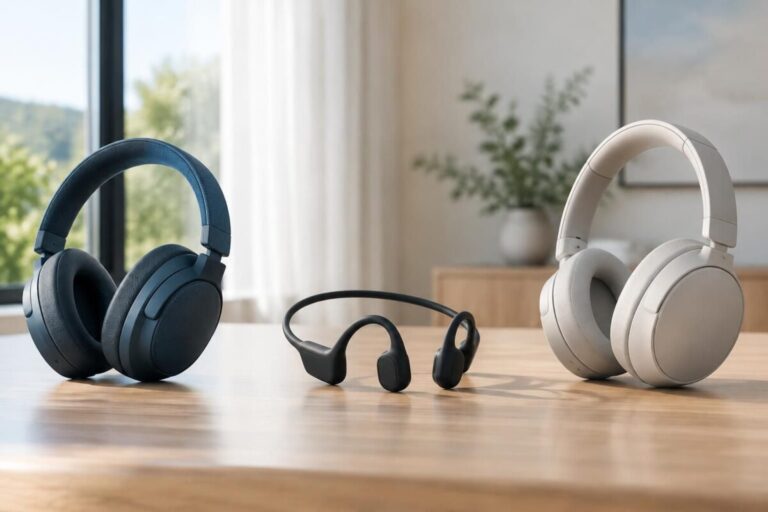
Bone-conduction headphones transmit sound through vibrations without blocking the ear canal. In-ear headphones, on the other hand, can offer a secure fit and better isolation, but their tips may become uncomfortable during a long or very hot workout.
Imagine Lina, who runs along an avenue and then finishes her workout at the gym. Open-ear headphones let her stay alert to bikes outside; for weight training, well-fitted ear tips may stay in place better during floor exercises. So the ideal style depends on the activity.
Sports headphones comparison: styles and models to consider
A useful sports headphones comparison goes beyond sound quality. You should also consider how they sit on your ears, how stable they are, and how well they resist sweat and splashes.
| Model or style | What sets it apart | Best for |
|---|---|---|
| soundcore AeroFit Pro | Open-ear design, up to 14 hours of advertised battery life per charge, and a detachable neckband | Long workouts and outings where you want to stay aware of your surroundings |
| Shokz OpenFit | Lightweight, sweat-resistant open-ear headphones | Running and outdoor activities |
| soundcore Sport X20 | Adjustable hooks, active noise cancellation, and advertised protection against water and dust | Intense indoor workouts when you want isolation |
| JLab Go Air Sport | Flexible hooks and IP55 protection | Budget-friendly sports use, whether you’re sweating or caught in light rain |
| Beats Fit Pro | Stability wings and active noise cancellation | Gym workouts with dynamic movements |
| Sennheiser Momentum Sport | Multiple ear tip sizes and IPX4 protection | Athletes looking for detailed sound and a personalized fit |
Features vary by version and usage conditions: always check the IP rating and battery life listed for the model on sale. Effective noise cancellation can be enjoyable at the gym, but it’s not the right choice near traffic.
What “letting your ears breathe” really means
Headphones without isolation don’t seal off the ear canal in the same way as in-ear tips. This can reduce the feeling of blocked ears, but it doesn’t by itself guarantee better airflow or protection from loud sounds.
When it comes to sweat and headphones, water resistance is a separate consideration from comfort. An appropriate IP rating can help you choose a model for sweaty workouts, but it doesn’t mean the headphones can be submerged or cleaned under a powerful stream of water.
Three steps to finding headphones for running or the gym
- Choose your setting. For running in the city, favor open-ear headphones; for isolating yourself at the gym, an in-ear model may be a better fit.
- Test the fit. Try the ear tips or hooks and move your head, do a few small jumps, or try a few squats. Nothing should slip or put painful pressure on your ears.
- Check the practical details. Compare sweat protection, battery life, and Bluetooth connectivity. Keep the volume at a reasonable level, especially if you’re wearing noise-isolating headphones.
This method helps you avoid a common mistake: choosing based only on bass or noise cancellation, then discovering that the model slips during your first few sets. A stable fit suited to your surroundings matters just as much as sound.
Frequently asked questions about breathable sports headphones
Are open-ear headphones suitable for the gym?
Yes, they can be a good fit if you want to hear announcements and the people around you. In a very noisy gym, noise-isolating headphones may block out noise more effectively, as long as you remain aware of your surroundings.
Are bone-conduction headphones really tip-free?
Yes. They are generally positioned near the temples and transmit vibrations without blocking the ear canal. This leaves the ears unobstructed, but the sound and bass differ from those of in-ear headphones.
How can I stop my headphones from falling out during a workout?
Choose well-fitting ear tips or hooks and check the fit with a few movements before your workout. If the model still moves after trying several ear tip sizes, try a style designed for sports.
What protection rating should I look for against sweat?
A rating such as IPX4 or higher is generally recommended for resistance to splashes and sweat. Read the manufacturer’s guidance: water resistance doesn’t automatically mean the product is designed to be submerged.
Thanks for reading! Feel free to share your thoughts in the comments. — Gérald